Monday, January 15, 2007

How’s the High School Doing? The 800 pound gorilla.

Today's trivia question to prepare you for the “Clash of Civilizations”.
What does raison D'être mean ?
Raison D'être is a French phrase which roughly translates as "reason to be". When used within the English language, it means "the basic reason to exist".....
First a wee bit of history. The raison D'être for free universal public education (public school) was delineated in the 1840s by the common-school reform movement. It was argued that common schooling (free universal public education) could create good citizens, unite society and prevent crime and reduce poverty. I think that the Knox High School Graduation Rate demonstrates a failure of our High School to live up to this essential raison D'être.

The reason for my pessimistic view is the Graduation Rate. I think that the official rate of 72% is overstated. We graduated 102 in 2005-2006. The enrollment in 9th Grade in 2002-2003 was 179. 102 divided by 179 equals 57%. That is the simplest way to examine graduation rate. The expected response from the education bean counters would be: Well that doesn’t account for kids moving out, or home schooling, or going to Culver Academy, etc., etc. But kids move back in, kids go from home school back to public school, and kids drop out of Culver Academy. Enrollment system-wide hasn’t fluctuated more than about 1% the past 5 years. In 2002-2003 we had 2,032 enrolled. In 2006-2007 we have 2,039 enrolled. There isn’t much net movement in and out. I think that our Real Graduation Rate is 57%.

The most oft cited reason (excuse) for our poor performance is poverty. The measure that is most often used is Free Lunch statistics. Here are some comparative statistics. The set of figures on the right of the lines below are the 9th Grade 2002-2003 enrollment divided by the 2005/2006 graduates. I call that the Real Graduation Rate (RGR)

Knox........ 72% grad 37% Free Lunch
.................102/179 = 57% RGR
N Judson. 73% grad 25% Free Lunch
..................94/126 = 74% RGR
O.D.......... 68% grad 23% Free Lunch
..................30/55 = 55% RGR
Plymouth.. 81% grad 23% Free Lunch
..................218/252 = 86% RGR
Winamac.. 86% grad 18% Free Lunch
..................105/115 = 87% RGR

North Judson, Winamac, and Plymouth get the honesty award. Their Real Graduation rate is very close to their official rate. Knox and Oregon Davis get the fibber award for having a much worse Real Graduation rate than their official rate. The poverty reason for poor graduation rates is statistically supported. Knox has a very high Free Lunch rate. (There are interesting little tidbits in the little chart. Compare Plymouth and O.D. with the identical Free Lunch programs.)

But let’s get back on the issue. How is Knox High School doing? With a Real Graduation Rate of 57% (or for that matter, even a 72% official rate) our school is a disaster. Those non-graduates will be highly likely to be on public assistance. They will be highly likely to be criminals. They will be highly likely to contribute to local societal disintegration. Poverty may be a cause of the problem but not an excuse. The school has not made a concerted effort to address this problem. By concerted I mean from the top to the bottom. That means that the School Board is where the solution must start.

I think that this is an overwhelmingly serious problem at Knox High School. The mission and reason for the school’s existence is to create decent and educated citizens. In this mission we are failing. This is a problem that should be addressed at every School Board meeting. Administrators should consider it to be their number one problem. But our School Board does not seem to even recognize that there is a problem. That is THE problem! There is an 800 pound gorilla in the room, but no one notices.

...an example of the word raison D'être...

Thursday, January 11, 2007

How’s the High School Doing?

Diogenes 1860 by Jean Leon Gerome 1824-1904 Walters Art Museum (United States)

Today's trivia question to prepare you for the “Clash of Civilizations”.
Who was Diogenes of Sinope?
Diogenes "the Cynic", Greek philosopher, was born about 412 BC. Legend says that he would search the streets of Athens in full daylight with a lantern, “searching for an honest man”. Diagenes was the first “performance” artist. See fascinating entry at Wikipedia: http://en.wikipedia.org/wiki/Diogenes_of_Sinope ........

How’s the High School Doing?
For those readers that want a quick summary and don’t want to wade through my sometimes turbid, often turgid, prose, the answer is Crappy!

The word lie (falsehood, fiction, falsity, fib) is so ugly, it is always regretful to use it. To call someone a liar really questions the core of an individual’s integrity. However there is a tendency among administrative educational professionals (especially Superintendents of Schools) to spin the truth to a degree that a plain thinking sort of person might suspect a lie. When nationwide thousands of educational professionals all agree to spin together I guess each individual is no longer considered a liar. So, thank God, I don’t have to call anybody a liar.

For years Knox, Indiana, and US high schools have been systematically fibbing about the graduation rates. The mathematical formula used in prior years was so absurd that it must have been devised for the sole purpose to hide the actual numbers. For example, Knox usually had a 9th grade enrollment of near 200 and a graduating class of 120 or so. It didn’t take a genius to figure that 60% of the students were going somewhere besides the graduation ceremony. Yet Knox routinely has claimed an 85% or even 90% graduation rate. The old way of figuring the dropout rate was so astoundingly bogus that it had become a national scandal. So now the Departments of Education have a new way of figuring the rate and now claim a 72.3% graduation rate at Knox.

So how’s Knox High School doing? Comparatively speaking that is? (That’s the kindest way to look at things.) Compared to the rest of the State of Indiana, we are deep, down and bad. 56% of Indiana high schools had 80% or greater graduation rates compared to our 72% rate. And when it comes to those that do graduate, 45% of Knox graduates pursued a college education (2005-2006) whereas the Indiana state average was 75%. (Caveat: these college education figures are suspect and have not been reformed and revised in the same way the graduation rates have been brought up to date.) But, even given the parenthetic caveat, we seem to be doing quite poorly in the category of sending our kids off to college. Less than 1/3 of our high school 9th graders will pursue a college education. And here’s an ugly little surprise. It isn’t teenage pregnancy that is driving up the dropout rate. The male student graduation rate was 66%, female 79%.

I think this is a disaster. I don’t want to take the space and time here demonstrate how much it costs our society to have so many failures and ignorant citizens coming our of our schools. Our school board blithely continues to worry about cheerleading, band and sports. When an enterprise is failing you can ignore it or you can try to do something about it.

Here is a list of the School Board Members:
Mike Yankauskas Term Ends: 2010-12-31
Jerry Fletcher Term Ends: 2008-12-31
Mary Lynn Ritchie Term Ends: 2010-12-31
Linda Belork Term Ends: 2010-12-31
Gary Dulin Term Ends: 2008-12-31
Richard Masson Term Ends: 2008-12-31
Harold Welter Term Ends: 2008-12-31
.
.
Some charming examples of Diogenes in contempory culture:
Mudd Memorial Hall of Philosophy, UCLA, 1928 Ralph Carlin Flewelling


Diogenes Lantern (Calochortus amabalis) northern California mountain wildflower

Monday, January 08, 2007

The Oath of Office Part 2

Bill of Rights: Engrossed Bill of Rights, September 25, 1789; General Records of the United States Government; Record Group 11; National Archives.

Today's trivia question to prepare you for the “Clash of Civilizations”.
What is the Establishment Clause?
The First Amendment of the United States Constitution, part of the Bill of Rights, contains this clause, "Congress shall make no law respecting an establishment of religion", known as the Establishment Clause............
.
.
On December 16, 2006 United States Court of Appeals for the Fifth Circuit ruled that the Tangipahoa Parish, Louisiana, School Board acted improperly by promoting their own sectarian religious beliefs during meetings.

From the ACLU Press release:
“The appeals court upheld the district court finding that the school board had improperly recited sectarian prayers during meetings. Prior to the appeal, both the school board and the ACLU recognized that the school board’s prayer practice fell outside of the 1971 Supreme Court decision in Lemon v. Kurtzman, which held that government action must have a secular purpose, neither advance nor inhibit religion, and not become excessively entangled with religion. However, in filing its appeal, the school board argued that its actions fell under the protection of a 1983 Supreme Court case, Marsh v. Chambers. The Marsh case allows a legislative exception for non-sectarian, non-proselytizing prayers.
Today’s ruling rejected the argument that the prayers were non-sectarian, and instead found that they “aggressively advocate[d] Christianity.” But the court avoided dealing with the central issue of whether school boards in general fall under the Marsh exception.”

Well. There is absolutely no difference between the activities of the Knox Community School Board and the activities of the Tangipahoa Parish, School Board. The Knox School Board policy is to invite a Christian preacher to deliver a prayer to start every public board-meeting meeting. This recent court decision makes it quite clear that sectarian (Christian) prayer is not allowed. The Knox School Board is clearly in violation of the law. If they choose not to suspend the prayer policy, they will be in violation of their oath of office.

The Indiana School Board Oath:
"I solemnly swear (or affirm) that I will support the Constitution of the United States of America, the Constitution of the State of Indiana, and the laws of the United States and the State of Indiana. I will faithfully execute the duties of my office as a member of this governing body, so help me God."

Members of the School Board have religious freedom. Members of the Board are free to kneel and pray any time they so desire, even during a School-Board meeting. The ACLU has fought for their religious freedom to do just that. The ACLU has fought for the right of Christian students to distribute Christian literature at the school. The ACLU has fought for the right of students to conduct prayer meeting at their schools.

Why is it that our school board insists upon this prayer policy that was of dubious legality from its inception? I am not inclined to give the board the benefit of the doubt. I do not believe that the board’s motivation was spiritual, or even Christian. I believe that they wanted to prove their radical right-wing credentials. They wanted to proclaim that they didn’t care what the courts of the land rule; they were going to defy the law. This is self-indulgent, sanctimonious, crap that has nothing whatsoever to do with the education of our students. Well it is now abundantly clear that they are in violation of the law. They are now criminals. I doubt that they care. They are most likely quite proud of themselves.

Friday, January 05, 2007

The Oath of Office Part 1

House Speaker Nancy Pelosi (left) Administers the House oath to Keith Ellison as his wife holds The Holy Quran. The Library of Congress’ division of rare books and special collections made the Quran available to Ellison for January 4 ceremony at the Capitol Hill. The oath was administered by the new Speaker of the House Nancy Pelosi.

This is the time of year our newly elected officials swear the oath of office. It can vary but it usually runs about like the Indiana School Board Oath:
"I solemnly swear (or affirm) that I will support the Constitution of the United States of America, the Constitution of the State of Indiana, and the laws of the United States and the State of Indiana. I will faithfully execute the duties of my office as a member of this governing body, so help me God."

We need to be careful as to what we admire. We admire men and women of conscience. We admire men and women of duty, serving their fellow man. It does sometimes happen that conscience and duty are in conflict. Former Starke County Commissioner Kevin Kroft loudly bragged that he voted his conscience when his conscience was in conflict with the law. If he felt the law was wrong, he voted his beliefs in disregard of the law. He bragged that the voters put him in office for exactly that reason. (The issue was solid waste, his particular Bogyman.) Although Kevin Kroft happens to be a right- wing, self-proclaimed conservative, this sort of elevation of conscience over law is hardly limited to the right wing. Governmental officials across the political spectrum act the same way, generally with great pride, a puffing of the chest, at their courage and strength of conviction. Often the voters regard this behavior as admirable and agree.

Yes, civil disobedience is often admirable. At times it has proven essential for the preservation of American greatness. There is a great tradition of civil disobedience in America. Throughout US history there have been great waves of illegal political protest that changed the course of our history and often-helped preserve important American freedoms. The Underground Railroad is a wonderful example of courageous civil disobedience that helped preserve our nation’s great tradition of freedom.

However, when a public official takes office, he takes an Oath of Office. Elected officials and appointed officials must be sworn in to take office. That Oath is not a meaningless ritual. The Oath is a cornerstone of our system of government. The point of being in office is to change those laws with which you disagree not to disregard them. When you disobey the law against your sworn oath, you are not a hero, nor are you brave. You are a fool and a criminal and are dangerous. Our Republic means nothing when public officials feel they are above the law.


Tuesday, January 02, 2007

A suggested New Year Resolution

Frontispiece from The Songs of Experience by William Blake
Happy New Year!
Today's trivia question to prepare you for the “Clash of Civilizations”.
Who was William Blake?
William Blake (November 28, 1757 – August 12, 1827) was an English poet, painter, and printmaker. Largely unrecognized during his lifetime, his work is today considered seminal and significant in the history of both poetry and the visual arts. He has often been credited as being the most spiritual writer of his time. From Wikipedia........
A suggested New Year Resolution: Take a college course. Post secondary education has never been more accessible to Knox residents. Education is a unique asset. Come what may, divorce or bankruptcy, your education is always yours. Below are some programs that are relatively inexpensive, are easy to take, and are offer credits good towards graduation at Indiana Universities.

The College program closest to Knox is Ancilla College in Donaldson less than 20 miles away. Ancilla is a liberal arts junior college with a Catholic religious tradition in an ecumenical climate. Ancilla emphasizes personal attention to its students within small, supportive classes. The college is fully nationally accredited. 2 year Associate degrees are offered in Arts, Science, Liberal Studies, and Science in Nursing. There is also a 3 year Registered Nursing program. Ancilla has articulation agreements with 13 regional colleges and universities including Ball State, Indiana State, Indiana University South Bend, Purdue University North Central, and Valparaiso University. Costs are about $10,000 per year. A full range of financial aid packages is available. Those graduating from High school this year should start the application process now. March 10 is one early deadline for financial aid from Ancilla College Grants.
http://www.ancilla.edu/

Learn at home at your own pace. Enroll at any time. Earn top quality college credits. Indiana University offers 190 plus Undergraduate courses that you can take at home. An example would be: Economics > E201Introduction to Microeconomics (3 credits, total cost $620.00). Take only one course just for the fun of it. Some courses are online, some are correspondence. It is even possible to get a Bachelors of Arts in General Studies (120 credit hours). These are very high-quality courses that are fully transferable to all Indiana University Campuses. The cost for a 30 credit hour year is about $7,000. This is a genuine bargain for those students with the self-discipline to work at home. Regular financial aid is not available, however veterans’ and National Guard programs do apply.
http://scs.indiana.edu/pdf/ispcatalog.pdf

Ball State offers a similar program with 100 courses available to undergraduates:
http://www.bsu.edu/distance/independent/

Monday, January 01, 2007

On the History of the Negro in Knox Part 5


Today's trivia question to prepare you for the “Clash of Civilizations”.
What is the “ethic of reciprocity”?
The ethic of reciprocity or "The Golden Rule" is a fundamental moral principle found in virtually all major religions and cultures, which simply means "treat others as you would like to be treated." It is arguably the most essential basis for the modern concept of human rights. From Wikipedia, the free encyclopedia...............
.
I have heard it said many times that Knox is a Christian town. Well it is true that there are a lot of people go to church. Well it is true that they say their prayers before each school board meeting. Well it is true that there is a crèche on the courthouse lawn in December. If that adds up, then OK, we are a Christian town. But there is that pesky little “Golden Rule”. Without the “Golden Rule” we are not a Christian town.

Matthew 22.36-40 "Teacher, which is the great commandment in the law?" Jesus said to him, "You shall love the Lord your God with all your heart, and with all your soul, and with all your mind. This is the great and first commandment. And a second is like it, You shall love your neighbor as yourself. On these two commandments depend all the law and the prophets."

Knox is white; that is the situation today.
Knox is white because of our racist history and because of continuing racism.

African Americans do not live or work in Knox. The few exceptions prove the rule. We have an African American Postmaster. There are African American foster children and adopted children in the schools. There are no African American teachers, fire fighters, policemen, or librarians. There are no African Americans working in Walgreens, CVS, or 5 Star. Basically, when locals do the hiring, the hiring is white. If the Federal government does the hiring, then an African American has a fair chance.

I don’t believe that an African American family would be shown any cooperation by the realtors in Knox. I don’t believe that the school board would consider hiring an African American administrator or approve the hiring of an African American teacher. The local Realtors don’t display the Equal Housing Emblem do they? The school doesn’t celebrate Martin Luther King, Jr. day, do they? These are messages that say, “stay out” to African Americans.

Recently a local governmental board decided not to interview a very well qualified applicant for an administrative position because the applicant “seemed” to be African American from their employment history. Their so-called reasoning was that it was a waste of the applicant’s time to interview. An African American professional would not want to work or live in Knox. This seemed like an odd statement in light of the fact that that person had bothered to apply for the job!

Note on the usage of the words Negro. The word Negro is often considered offensive. I use it here to reference historic and scholarly documents and in order to capture the archaic flavor of life in Knox.

Saturday, December 30, 2006

On the History of the Negro in Knox Part 4

........Photo: King in Chicago in February 1966........

Am I crossing a dangerous line by writing about race in Knox? Of course I am. Am I saying anything that anybody doesn’t know already? Probably not. I suppose someone may very well ask, “Then why write about it? Why drag this stuff up? Aren’t you just making Knox look bad?” I write about it because Knox is my subject, my home, and this is a BIG part of Knox, then and now. And be aware that I am not making Knox look bad. The racists in Knox are the ones that make Knox look bad. Change is coming to Knox, perhaps more quickly than we can guess. Continued racial intolerance will hurt Knox’s citizens’ prospects for happiness and prosperity.

The 1960’s and 1970’s still are close enough in time to cause some discomfort. Knox, like so many other towns and cities in America, didn’t tolerate any blacks in town after dark. Black workers pass through town and maybe even have a job in town, but they had better not try to live here. Ugly? Yes indeed.

The great national social changes resulting from the civil rights struggles of the 1960’s had little or no impact in Knox. Certainly Martin Luther King, Jr.’s Nobel Prize in 1964 garnered no particular attention. Who knew or cared that King moved into the Chicago slums in 1966? But when the Chicago Freedom Movement (CFO) pressed to cross the residential racial lines in Chicago neighborhoods some howling was heard. At Bessie’ Restaurant in Knox, on weekends the Bass Lake cottage owners coming in from Chicago’s South side let anybody and everybody know their thoughts on the matter. In the late 60’s the race riots and the burning neighborhoods 80 miles away on Chicago’s south and west sides were cause to reinforce the fear that things were going to Hell.

I have heard a story from the 1970’s of a Black State Trooper and his family locating in Knox for a short time. The unsubstantiated story is that the volunteer fire department had made it clear that they would not be putting out any fires at that household. I have no idea if this is a true story. But the widespread acceptance of such a story is certainly an illustration of the background against which a black family could decide about locating in Knox. In the early 1970’s I witnessed a college coed home on vacation accompanied by her black dormitory roommate walking down the sidewalk in downtown Knox with little kids running behind them yelling, “nigger, nigger, nigger”.

In that same era, there was a devastating plant closing in Knox when Rockwell International left Knox. The plant was vacant and Knox badly needed to get a new industry located in the building. The principals of a black-owned industrial company came to Knox to inspect the site and check out the town. At the aforementioned Bessie’s Restaurant I overheard a prominent realtor bragging that he told these black industrialists that there were no homes for sale in Knox.

It is clear that the 1960’s and 1970’s were a horrible, perhaps impossible, time to be black in Knox. The blame doesn’t simply fall on the lower social-economic classes, the so-called rednecks. A leading citizen, a prominent realtor, was confident enough in the total acceptance of his racism to openly brag about it, in public, to his peers. He was essentially making sure that a new factory with black owners did not locate in Knox. This was a time of recession and high unemployment. Having a new industrial plant in Knox would have been a most-welcome development. I am totally certain that I would rather have as neighbors the owners of that prospective factory than that piece-of-work realtor and his accepting buddies at Bessie’s Restaurant.


Note on the usage of the words Negro and nigger. The word Negro is often considered offensive. I use it here to reference historic and scholarly documents and in order to capture the archaic flavor of life in Knox. The word nigger is always considered offensive; it is only used here because it is a quote from actual racist abuse. Please forgive any offense this may cause.

Friday, December 29, 2006

On the History of the Negro in Knox Part 3

Room Six, 1906, Knox High School, had 2 Black Students
Please click on the photo to have a closer look. I think a story could be written about the young man and young lady in question simply from studying this picture. The young man stands apart from the group, carefully choosing a background to enhance his appearance. He is very well dressed and is the only student with a hat. The young lady presses against the teacher and nearly fades into the background. Note the class clown next to our nearly invisible young lady. We could say that the young black man upstages the entire class and makes this a photographic moment just about him. The young black woman couldn’t be more invisible.


Today's trivia question to prepare you for the “Clash of Civilizations”.
What is the xenophobia?Fear or hatred of strangers, people from other countries, or of anything that is strange or foreign. From dictionary.com......................
.
What historical forces made Knox an all-white city? Indiana is an historically xenophobic state, perhaps more so than any other state in the union. From Indiana’s earliest days legal, political and social forces joined to keep out all sort of racial, cultural, and religious differences. So to a strong degree we simply reflect our State’s sorry-ass intolerant history. Although Indiana was a so-called “free” territory most of the early black residents of Indiana were essentially slaves. To the small degree that free blacks did live in early Indiana, they generally lived along the Underground Railroad routes where Quakers or other religious groups protected those fleeing slavery. As we established in Part 2 of this little series, Knox did not have an Underground Railroad or a friendly Quaker settlement. So there were no friendly, racially tolerant institutions in Knox to moderate the intolerant tone of the state.

In the early 20th century Knox was a Ku Klux Klan stronghold. In spite of that fact, several Jews and quite a few Catholics came to Knox and thrived. So it is a bit of a puzzle as to why no blacks came to Knox and endured. I have heard that there were isolated black families in rural Knox up to the 1940s. I have not been able to verify this fact. Perhaps a reader can help. A search a 1906 Sandbur yearbook from Knox High School revealed 2 identifiably black children. None could be found in the 1919 Sandbur.


One of the bright spots in Knox’s history is the conduct of our native son, Henry F Schricker. In 1949, during his 2nd term as Governor, Schricker signed House Bill No. 242, abolishing segregation and discrimination in public schools, colleges and universities. You can see Gov. Schricker’s prominent signature at the top of the bill just below the signature of the Speaker of the House.
Of course Knox had no black population to segregate so this bill was rather meaningless in its effect on Knox.
Note on the usage of the word Negro. The word is often considered offensive. I use it here to reference historic and scholarly documents and in order to capture the archaic flavor of life in Knox.

Thursday, December 28, 2006

On the history of the Negro in Knox Part 2

...................Underground Railroad Routes.............................


The question of race in Knox is perhaps slightly taboo. It’s really not as if Knox is either more or less racist than North Judson. I am not singling out Knox. It is simply that Knox is what I happen to write about. So I thought a little comic relief might relax the atmosphere of this topic a bit before we go into it any deeper.

A few years ago there was an absurd news story reported on television and in the newspapers that the Underground Railroad operated in Knox. Some silly Knox person started this story. Things got so far out of hand that local school kids came and viewed the remains of the Underground Railroad in downtown Knox. I assume their teacher debunked this story as soon as they got back to the classroom. It certainly is a false rewrite of history.

Under the sidewalk on Main Street, in front of O’s tavern, is a passage, pretty much an underground sidewalk. The owner of the building didn’t think that there was anything mysterious about it. Nor did anybody else with any sort of ability to think about it for a second. In the early part of the 20th century Knox downtown was a hustling, bustling place. The big retail stores on Main Street were valuable real estate. So valuable in fact that 2nd stories and basements were rented out to service and retail providers. It would not be a surprise to find a barber or a cobbler located down the stairs accessed on the sidewalk on Main Street. And that is exactly what the underground sidewalk in front of O’s tavern happens to be. These basement locations eventually lost their appeal and were mostly covered over. The last remaining basement stairwell and entry was filled in about 3 years ago when the old Main Street building above the basement was torn down.

Our local news outlets did their usual horrid job of uncritically reporting this silly story. The reporters knew quite well (I hope) that the story was complete crap. For reasons of their own, the traditional news outlets in Knox feel that they can only report what others say. They do not feel that it is their place to question or investigate. So they waited for some Ball State History Professor to say a dry "highly unlikely” a month later. .....Main Street appx 1918 note "Underground Railroad".......

I think that there is psychological significance to this story. I think this story allowed Knox to try to unload a little bit of its uninterrupted racist past by saying, “We helped slaves escape the plantations. Aren’t we good people?” Insisting the school kids “buy into” this mythmaking kind of makes my point, I think. Well Knox had nothing to do with the Underground Railroad. Mostly black people and Quakers operated the Underground Railroad. There were neither blacks nor Quakers in Knox. The history of the Underground Railroad is well documented. I have read “The Negro in the History of Indiana” by John W Lyda and found no reference to Knox or Starke County as a refuge for blacks.


Note on the usage of the word Negro. The word is often considered offensive. I use it here to reference historic and scholarly documents and in order to capture the archaic flavor of life in Knox.

Wednesday, December 27, 2006

On the history of the Negro in Knox Part 1

................................ Marian Anderson........................

Today's trivia question to prepare you for the “Clash of Civilizations”.
What is a Contralto?
In music, an alto or contralto is a singer with a vocal range somewhere between a tenor and a mezzo-soprano. The term is used to refer to the lowest female singing voice, or to a kind of male singing voice utilizing falsetto called a countertenor.
.


Please, allow me to go back a little bit in local history. I promise it won’t be a nostalgia trip like one of Ed Hasnerl’s “Good Old Days Back in the One Room School House”. Really, I promise! But it really is a shame that Ed isn’t doing this piece. I have a feeling that he knows a lot more about it than I do. Perhaps he will take up the challenge? We are looking forward to hearing from you Ed, “Speaking of Many Things”.


Prior to the 1960’s the powers-that-be in Knox were pretty easy to identify. They all hung around Bessie’s Restaurant on Highway 35 (where the liquor store is now). Once upon that time Marian Anderson came to Knox to sing a concert. Ah, and that she did. The world-famous classical music and Negro spiritual singer graced our high school gym with the most beautiful music that was ever or will be ever heard in our little city. The kind of embarrassing moment that most would just as soon forget came afterwards when Marian went to Bessie’s for a bite to eat. I wasn’t there, but I would guess that the leading citizens of Knox were crowded into their favorite eating spot. And I would guess that they didn’t jump up to object when fat Bessie refused Marian Anderson service.

Can you even imagine? Shortly after her Knox visit she was appointed a member of the US delegation to the United Nations. She had toured the world to the highest acclaim. Her final concert at Carnegie Hall, New York broke the heart of the nation.
Please. Please, visit
http://www.mariananderson.org/ to hear her sing “Lord I Can’t stay Away”, “You were There” and 10 other songs of astounding spiritual depth and beauty. Then imagine Bessie’s Restaurant that day.

Things have changed? Really? Yes, emphatically. But are there still problems of this sort? Yes, emphatically. I’ll go there in Part 2. Please stay tuned.


Note on the usage of the word Negro. The word is often considered offensive. I use it here to reference historic and scholarly documents and in order to capture the archaic flavor of life in Knox.

Tuesday, December 26, 2006

How’s the Library doing? Part 4

Detail of black-figure lekythos. Eretria.
By the Diosphos Painter.
Clay. Ca. 490 B.C.
Paris, Louvre Museum.

Today's trivia question to prepare you for the “Clash of Civilizations”.
During the Trojan War who was the greatest Trojan warrior? Who was the greatest Grecian warrior?Answer Hector, Troy and Achilles, Greece.

How’s the Library doing? Part 4

The radical Islamic world is now at war at with Western Civilization. Our young men and woman are in armed conflict defending our concepts of civilization. We admire the American soldier, guided by reason (Logos), superior training, superior equipment, superior tactics, and superior strategy. We do not admire the suicide bomber, inspired by jihad, the call of religious leaders for war. Our jihadic enemy yearns death. To him reason, logic, and justice don’t matter.

In America we question our leaders, we are free to doubt their wisdom, we do not yearn death at their behest. How is it that these two civilizations came to have such differing views of war and the role of the warrior?

The archetype of the Western Civilized warrior was born on the pages of a book 2,800 years ago when Homer wrote the Iliad. Homer describes a few days, at most a month, in the 10 year Grecian siege of the great walled city of Troy. You know the story of Troy: Helen of Troy, The Trojan horse. But Homer tells very little of that story in the Iliad. The story is about great warriors. These warriors knew fear and doubt. They knew courage and honor. If you want to understand what Western Civilization really means, I suggest that you read this book.

So how is our library doing in regards to having the Iliad on the shelf? There are several modern English translations in print. The one that our library has is Richmond Lattimore's version. The library also has an excellent critical text based on this translation. I can recommend this translation.

However, there are 2 more modern translations the library should acquire. These 2 newer translations have been accepted critically as the best modern English translations available. Both have excellent introductory text.
Robert Fagles (translator), Bernard Knox (introduction) 1990
Stanley Lombardo (translator), Sheila Murnaghan (Introduction), 1997

From http://en.wikipedia.org/wiki/Iliad
“Robert Fagles and Stanley Lombardo both follow the Greek closely but are bolder in adding dramatic significance to conventional and formulaic Homeric language.
Lombardo has chosen an American idiom that is much more colloquial than the other translations.”

The Grecian Urn at the top shows Achilles on a chariot dragging Hector’s body.

Sunday, December 24, 2006

Polar Bears & Penguins

Annunciation - Leonardo da Vinci, circa 1472–1475 Uffizi, Florence
Today's trivia question to prepare you for the “Clash of Civilizations”.
What is the Annunciation? Answer: In Christianity, the Annunciation is the revelation to Mary, the mother of Jesus by the archangel Gabriel that she would conceive a child to be born the Son of God. (From Wikipedia, the free encyclopedia)


Polar Bears & Penguins

Dear gentle reader. There is a tendency towards rather dubious groupings of Christmas decorations. I think that a Santa scene with sleigh and reindeer shouldn’t be grouped with a crèche Nativity scene. To create a more artful and tasteful display one would be advised to enlarge upon one particular Christmas theme. For example, if you want to go with Santa, then add a North Pole, a Mrs. Santa, a workshop with elves, etc. If you prefer the religious then go all out with a Nativity scene. You’ve got camels, wise men, shepherds, sheep, the guiding star, precious gifts, angels and any number of barnyard animals (but for heaven’s sake don’t make the rookie mistake of adding swine). Your good taste will we reflected in your display of moderation. Your neighbors will envy your courage to do more with less. When all else fails, ask yourself, “What would Martha Stewart do?” Lately I have seen very dubious additions to the old usual pantheon of Christmas characters. There are now blow-up 7-foot tall Christmas characters. The particular pairing shown in this photo shows a nasty trend that started showing up a few years ago. That nasty trend is the MIXING OF FAUNA OF DIFFERENT POLAR REGIONS. Simply for the sake of cuteness polar bears and penguins started showing up together! This is WRONG! Polar bears live in the Northern Polar regions, i.e. the Arctic. Penguins live in the Southern Polar regions, i.e. the Antarctic. This reflects sloppy thinking. I fear it will infect our youth and lead to heaven knows what sort of weird tendencies in the next generation. We should all refrain from this mixing of fauna in future Christmas seasons. Please sacrifice this display of animal cuteness for the sake of our children’s minds.


Friday, December 22, 2006

Announcing: Teats* On A Boar Award

Detail from an Athenian black-figure clay vase, about 510 BC. Mus'e du Louvre, Paris

Today's trivia question to prepare you for the “Clash of Civilizations”.
What was the Erymanthian Boar?

Click here and Scoll down to "Interests" for the answer.


I would like to nominate 2 local entities for the “Teats On A Boar Award”:
Terry Turner’s NewsHawk
The Starke Memorial Hospital Board of Trustees

The NewsHawk’s 12/20/06 front page story, ‘Roush “Guilty” in 2nd lab test cover-up trial’, gets my nomination for Teats On A Boar Award because of worthless reporting and for what was intentionally left out of the story. Terry Turner knows that the guilty party, Christina Rousch, is the daughter of Roger Braman. Terry Turner knows that Roger Braman, of the eponymous funeral home, is a member of the Starke Memorial Hospital Board of Trustees. THIS IS NEWS! Roger Braman’s daughter Christina Rousch was employed by the Starke Memorial Hospital. In her capacity as a lab technician Christina Rousch came into work on her day off and tried to cover up a felony Homicide. A public official gets his daughter hired (a clear case of nepotism) and the public official’s daughter is guilty of a horrible crime related to her employment. THIS IS NEWS! There is more. Mr. Braman asked the hospital to pay his daughter’s legal costs. THIS IS NEWS ! Someone in the law enforcement community gave Roger Braman advance notice of his daughter’s arrest. This allowed Christina a little extra time to evade the warrant to prepare for questioning. I should think that this matter is of interest to the Starke County Prosecutor and THIS IS NEWS! Because the Newshawk’s news coverage is so very deferential to those in power I think this newspaper is worthless as TEATS ON A BOAR. So the NewsHawk is my first nomination for the new Teats On A Boar Award.


Why is there such a thing as the Starke Memorial Hospital Board of Trustees? After all our hospital is leased to Lifepoint Hospitals, Inc. Lifepoint operates 52 hospitals nationwide LifePoint Hospitals is a publicly traded company listed on the NASDAQ under the symbol "LPNT." The local Board of Trustees has little or nothing to do. They are as worthless as TEATS ON A BOAR. According to Indiana Code 16-22-2 the Board of Trustees is entitled as follows: “Each governing board member may receive annual compensation not to exceed three thousand six hundred dollars ($3,600) with compensation to be fixed by the board.” (I don’t know but I’ll bet this board takes the maximum.) And “A board member may receive group health and life insurance benefits paid by the hospital. Health and life insurance benefits are not considered compensation.” (I don’t know but I’ll bet this board gets a nice insurance package.) And “A board member may attend meetings and seminars for the benefit of the hospital with the cost of the meetings and seminars paid by the hospital. A payment made by the hospital under this subsection to a board member is not considered compensation.” (I don’t know but I’ll bet this board gets some nice vacations.) The Starke Memorial Hospital Board of Trustees is as worthless as TEATS ON A BOAR. So they are my other nomination for the new Teats On A Boar Award.


The following email inquiry was sent to Brian Dietz - Chief Executive Officer Starke Memorial Hospital:
Please provide the following information.
Who are the members of the Starke County Memorial Hospital Board of Trustees?
What are the duties of the Starke County Memorial Hospital Board of Trustees?
What is their annual compensation?
Do they receive health insurance benefits?
If yes, what is the value of those benefits?
Does the Board of Trustees attend seminars and meetings at the expense of the hospital?
If yes, please list and describe these seminars and meetings, members in attendance, and the cost underwritten by the hospital.
Marian Cross
Author knoxindiana
http://knoxindiana.blogspot.com/

*Note:Some may spell it tits not teats. However a tit (short for titmouse) is a cute little bird. Illustrated below. I have never seen tits on a boar.
prior blog posted on this subject: Knox Blues, Part 1: Nepotism 101

Monday, December 18, 2006

“God help your soul.”


Today's trivia question to prepare you for the “Clash of Civilizations”.
Who was Torquemada?
Tomás de Torquemada (1420 - September 16, 1498) was a fifteenth century Spanish Dominican, and an Inquisitor General. For his role in the Spanish Inquisition, Torquemada's name has become a byword for cruelty and fanaticism in the service of the Catholic Religion. From From Wikipedia, the free encyclopedia @ wikipedia.org

“God help your soul.” was comment made by Anonymous to my last post. I imagine Torquemada was fond of that same phrase. Could we correctly call it a Torquemadish comment?

I deleted part of Anonymous’ comment in the last post. Anonymous accused me of perhaps being one (or more) of 4 different people. One of those people Anonymous named is a teacher in the Knox School System. Then Anonymous wrote: “It's clear that your purpose in life is to destroy the lives others rather than be a positive force in the community. God help your soul. I think it's great that you believe in anonymity. So, you should have no issue with posting my anonymous comments. If you're going to point fingers let's, make sure their [sic] not pointing back at you!”

I think that the above may be a threat! What do my readers think? The comment “God help your soul.” bothers me. It sounds as if Anonymous has decided to embark on a vendetta. Particularly after Anonymous begins naming teachers as the “real” author of this blog, I fear that there may be repercussions directed against some poor teacher in the Knox School that happens to have no idea! BTW: I am not a teacher, I am novelist (not currently working) That is truly alarming. If Anonymous is in a position of power within the school corporation, I fear that some innocent bystander may very well get harmed. I know of no way to prevent that from happening short of just shutting down this blog. I don’t think that would be a good thing to do in a free society.

I would like to repeat what I have said many times already: Tell me where I have written a lie and I will happily correct the record and apologize. I am trying to get the facts straight. When the response to a blog is a veiled threat, I think that more likely than not, this is a response to an unpleasant truth. If it was a falsehood, Anonymous, would tell me where I got the facts wrong, wouldn’t you think?

Saturday, December 16, 2006

Public Finance 102, Tale of Two Too Many Toilets

Today's trivia question to prepare you for the present “Clash of Civilizations”.
What or who is an iconoclast?
The 2nd meaning in The American Heritage® Dictionary: “One who destroys sacred religious images.” The Taliban destroyed famous Afghan Buddhas in 2001. This is part of the continuing history of Islamic Iconoclasm. There is also a history of Protestant Iconoclasm especially common during the reformation

Public Finance 102, Tale of Two Too Many Toilets
Behold the power of Municipal Bonds! Take a look at the absolutely amazing expansion of the playing fields south of the Knox high school. Beautiful! Just a very few years ago we had a cinder track and no baseball diamond. The school board has transformed 2nd rate outdoor athletic facilities into 1st class facilities. I certainly hope the taxpayers appreciate these wondrous improvements in the athletic fields because they are paying for them. And I think that, by and large, the taxpayers think things look pretty good, so they kind of don’t mind too much. HOWEVER (as you have probably already guessed) I think that there is a problem. A big problem.

This last year we read in the newspapers and heard on the radio about the terrible budget crunch at the schools. There was talk that some teaching positions may have to be eliminated. The teachers settled for 1% pay raise and a 1-day cut in days worked (with no cutback in actual student teaching days). Harold Welter’s comment about the teacher’s rather pitiful pay rise, “More pay for less work”. Not accurate. Not charming. This is horrific labor relations by a school board member who happens to be representing us, the taxpayers. We hope our School Board would at least try to keep the peace with labor. You can pretty much bet that when the next teacher’s union contract rolls around Harold Welter’s comment will be very well remembered. Anyhow, as I way saying, the school certainly seemed to have a genuine budget crunch.

So there can be marvelous improvements in the facilities and at the same time deterioration in the operation of the schools. The reason: Debt Service (Municipal Bonds) pays for the facilities and, on the other hand, the Operating Budget is tightly constrained and that pays for the operation of the facilities.


So begins my Tale of Too Many Toilets. There are 3 separate concession stand/ toilet buildings on these playing fields. There is only a real need for one centrally located building. There is also a separate equipment, training, locker room and shower facility next to the football stadium. It is really obvious to the most casual observer that there should be 1 centrally located building incorporating all the needed facilities: lockers and showers and public restrooms and concession stand.

I estimate that the operating funds needed to maintain these redundant facilities is 5% of replacement cost per annum. Furthermore, heating, cleaning and security add up to another 5%, estimated debt service is an additional 10% (interest rate plus principle repayment). My estimated replacement cost of the 2 redundant toilets facilities is $100,000. So it costs us (the taxpayers that is) a wasted $20,000 per year because of bad planning and redundancy of the toilets!

Of course it gets worse. The grandiose (overbuilt) football stadium, the state of the art track, a dozen extra tennis courts. And MILES of poorly planned and redundant chain link fences. Guess what the life expectancy of the high-tech track surface and the tennis courts is. Guess how much intensive labor is needed to mow and trim a mile of unneeded chain link fence. Here are some waste estimates:
2 unneeded concession stands/ yearly waste $20,000
6 unneeded tennis courts replacement cost $250,000/ yearly waste $50,000.
5,000 feet of wasted chain link fence $100,000/ yearly waste $20,000.
1,000 feet asphalt paved roads $400,000/ yearly waste $40,000.
Overbuild stadium and training facility/ $300,000/ yearly waste $60,000
TOTAL YEARLY WASTE ON THE OUTDOOR ATHLETIC FIELD COMPLEX: $190,000.

Yet this is actually small potatoes! Add the overbuilt Middle-School and the luxurious furnishings (fancy electronics, grand piano, fancy stage equipment, fancy music department (all paid for with Municipal Bond Debt) you quickly come to understand the reason we have a money crunch in the school system. The fact is that there are not sufficient operating funds to maintain the buildings and the fancy equipment. The school has already been forced to reduce the janitorial and maintenance budget! Imagine the accelerated deterioration of the building and equipment. We will be lucky if half this stuff isn’t rotted away before the bond is paid off.

Tuesday, December 12, 2006

Public Finance 101

Today's trivia question about Western Civilization:
Who was the President of the USA during WWI?
Who was leader of Germany?
Woodrow Wilson / Kaiser Wilhelm II

This little blog is about Municipal Bonds. If you were an investor and wanted a little tax-free interest you could buy a Municipal Bond. Our schools and libraries are usually built with debt issues in the form of municipal bonds. When the school or library builds a building, it sells a bond to investors. The investor that offers the lowest interest rate buys the bond and collects tax-free interest that the school or library pays.

There are different types on Municipal Bonds. Lets talk about the difference between a Revenue Bond and a General Obligation Bond. A General Obligation Bond means that the taxpayers are responsible to pay the interest and principle. These payments are added to your property tax bill. The schools call this debt-service. It has happened on occasion that governments can issue so much debt that property taxes become so high that property owners abandon their homes rather than pay the tax bill. Thankfully this is a very rare occurrence. The risk of default by the government is the risk that investors bear and it is the reason some bonds have higher rates than others.

Taxpayers are not responsible to pay back Revenue Bonds. Revenue Bonds are issued on projects that are projected to make enough money to pay off the debt without involving the taxpayers. For example, a new terminal at an airport might be rented to an airline and that Municipal Debt would be paid for by the Revenues from the airline's rent. The inventors in this case would estimate the quality of the project and demand interest rates that are in line with a risk that the project won’t make enough money to pay them back. These debt payments are not added onto your property tax bill.

When the Knox Community center was proposed, the then Mayor Dembowski said that the project would be paid for by investors, clearly implying that the bond would be a Revenue Bond. Originally the hospital was involved in the project and indeed there was a prospect of a health club and physical rehabilitation facility anchoring the project, so it was possible that it could have been a Revenue Bond. Of course all that fell through, but the project went forward. The then-owner of local paper, “The Leader” pushed hard for the project. He refused to print negative letters to the editor and helped sell the idea that “investors” were going to pay for the project. Coincidentally, he had some decrepit property in the area of the proposed project. So the project was sold to the public on the premise that there were “investors” behind it, implying a Revenue Bond not a General Obligation Bond.

So let’s cut to the chase. We have a Community Center and there was no investor willing to bet that the revenues from renting it out for meetings could possibly pay back the debt. So it was financed by a General Obligation Bond. Those payments are right there on your property tax bill. Maybe it was a good project, maybe not. It was sold under false pretenses with the local paper aiding and abetting. Sure there were the required public notices, meetings, etc. Nothing illegal.
I am hoping that with the existence of little blogs like this one that this sort of local newpaper cover-up won’t ever happen again. Support your local blogger!

How’s The Library Doing? Part 3

How’s The Library Doing? Part 3

Introducing a new feature at KnoxIndiana, trivia questions about Western Civilization. Consider this a warm up for basic training in the clash of civilizations!
Today’s Question:

What is a Pyrrhic victory?

Pyrrhic victory: A victory that is accompanied by enormous losses and leaves the winners in as desperate shape as if they had lost. Pyrrhus was an ancient general who, after deafeating the Romans, told those who wished to congratulate him, “One more such victory and Pyrrhus is undone.”
From "The Dictionary of Cultural Literacy", Hirsch


(Pardon the interruption. Today’s Blog Post starts here. )

Thomas Cahill: Starke County Public library has 3 out of 5 books from his new series, “Hinges of History”.


As we are often reminded, nowadays being post 9/11, there is a clash of civilizations taking place. Characterized as Islamic Civilization versus Western Civilization or as Pope Benedict XVI put it more specifically in his now famous lecture at the University of Regensburg in Germany, it is a clash of the Reason /Logos of Christianity/Western Civilization versus the Irrationality of Islam. (Of course my summary of the Pope’s lecture is over-simplifies his argument.) This clash is happening, I suppose, but it begs the question, “What is Western Civilization?” I fear that many Americans don’t really have a very good grasp of the subject.

There is a clever, refreshing and readable series of books that help answer the question. Thomas Cahill has written 5 books that comprise a planned set of 7 volumes that are collectively called the “Hinges of History” series. The 5 volumes in print constitute a fresh look at what is “Western Civilization”. These are great reads, clearly written and fresh. A bonus is that they are all self-contained. There is no need to read them in order or any particular reason to read all of them. These are highly recommended by me, Blogger, KnoxIndiana. Here is a list of the books:

(Our Library does not have)
How the Irish Saved Civilization: The Untold Story of Ireland's Heroic Role from the Fall of Rome to the Rise of Medieval Europe

(Our Library does not have)
The Gifts of the Jews: How a Tribe of Desert Nomads Changed the Way Everyone Thinks and Feels

Desire of the Everlasting Hills: The World Before and After Jesus
From the author’s web site:
http://www.randomhouse.com/features/cahill/bio.html
Desire of the Everlasting Hills: The World Before and After Jesus was proclaimed by The New York Times Book Review as "a stunning success, the best of the series." Published in hardcover in November 1999 on the occasion of the two-thousandth birthday of Jesus of Nazareth, it hit bestseller lists across the United States with over 402,000 copies in print. Instantly after release, the paperback debuted on The New York Times Bestseller List at #4 on March 11, 2001. This volume brings a fresh and engrossing look at the impact of Jesus and early Christianity on the shaping of Western civilization. Again, with his unique and stimulating ability to re-create ancient times, Thomas Cahill vividly brings to life Jesus and the people who wrote about him, and offers a stunningly original interpretation of the New Testament.

Sailing the Wine-Dark Sea: Why the Greeks Matter

Mysteries of the Middle Ages: the rise of feminism, science, and art from the cults of Catholic Europe

Monday, December 11, 2006

Beautiful Living Not Allowed

I left too much unsaid in my last blog about 1,000 square foot houses. Unmentioned were old and strong memories from a childhood in Great Britain. These memories form the basis for my great displeasure with a building code that treats small homes as some sort of inferior entity, unworthy of Knox.

As a young girl, I spent a summer with my Aunt Ferine in a lovely little village in a region of England called the Cotswold. If you’ve been to Disneyland you have seen the idealized version of the thatched roofed stone houses common to this area. Ferine lived in a small cottage very much like the one pictured here. The walls were at least 2 feet thick so that the windowsills were cozy seats. A very small front garden and a small-stonewalled flower and veggie garden completed the property. Her home was delightful, offering a quality of life hard for Knox dwellers to imagine. Let me assure you that this home did not have a 1,000 square foot ground floor. I would say it was 500 or 600 sq ft ground floor with 2 small attic bedrooms.

I think that the whole point of zoning ordinances is to facilitate quality of life. If that is true, then the possibility to build a home designed to facilitate a certain high quality of life is closed because of zoning. In the Cotswold region are villages that architectural experts and experts on city planning say are the most livable in the world. The center of these villages is most often attached row houses that in America we might call town houses. This form of housing has been successfully replicated in some cities in America. There are city blocks just south of the Chicago Loop that have been built recently that attempt to capture the qualities of these row houses and actually come close. Whereas it is very difficult to do in Chicago due to security issues, it would be easy to do in Knox. Sadly, our zoning ordinance closes this and most other possibilities for attached housing.

R-3 Residential (Multi-Family) would be the needed zoning designation for building a row house or townhouse. It is almost beyond belief but there is NO AVAILABLE land in this plan to build any R-3 Residential (Multi-Family). The only parcels of land so designated are already developed apartment complexes. Why in the world would a city plan simply exclude the development of any townhouses, condominiums or apartment buildings? Is it hatred of people that might want to live in any manner in which the Shillings don’t approve? Is the only “proper” way to live in a house more than 1,000 square feet on lot more than 80 feet wide and 150 feet deep with a correct side yard and front yard? Emphatically, no! This is not the only proper way to live, nor is it even the best. The Shillings and our City Council only let us have a narrow, perhaps bigoted, range of possibilities.

Below is a lovely photo of row houses in Bibury, England, often thought of as the most beautiful village in the world. Note: big houses and little houses all in a row.

Saturday, December 09, 2006

Public Citizen, Jim Shilling, Knox Master-Planner part 2

Public Citizen, Jim Shilling, Knox Master-Planner part 2
Here is Part 2 of the story

Area: R-1 Residential
Minimum Ground Floor Building Area

According to the Planning Ordinance the minimum ground floor building area for new single-family dwellings in Knox is 1,000 square feet. There are many homes in Knox that are less than 1,000 sq feet. I think many of these small homes are quite attractive and useful for small families, couples, or singles. On Pearl Street and all around Knox are many fine examples of small homes. Here is a picture of one of the attractive cottage style homes on Pearl Street. It appears to be 600 or 800 sq. ft on the ground floor.

I can understand a subdivision covenant requiring over 1,000 sq. ft. People with luxury homes or moderately luxurious homes want to protect property values in their neighborhood. For an entire city to have such a requirement certainly seems puzzling. Especially considering the character of Knox and the demographics of Knox are very suitable for small, modest housing. Below is a typical floor plan of a modern home with less than 1,000 sq feet. Wouldn’t this be a perfectly suitable space for a single or couple or even a family of 4?

I assume the reason for the ordinance is to keep out the so-called lower classes or just to severely limit growth. The present Zoning Ordinance is destructive and stupid. It was adopted by the City Council with no debate or even thought. It needs to be changed.

Thursday, December 07, 2006

Public Citizen, Jim Shilling, Knox Master-Planner part 1

Here is Part 1 of the story I promised as a follow up to my earlier blog,
A Community Activist, Public Citizen, Jim Shilling
From Monday, November 27, 2006
http://knoxindiana.blogspot.com/2006/11/community-activist-public-citizen-jim.html

Please read the paragraph below slowly and carefully. It is the law in our city of Knox. And I think you will be surprised to see how it strongly affects the future of our city.

TITLE III. A
AGRICULTURAL DISTRICT
Section 1. Intended Purposes

The purpose of this zoning district is to conserve and enhance the agricultural use of substantial portions of the City of Knox planning and zoning jurisdiction that now, and for a distant future of time, should have such character, and to prevent scattered, indiscriminant urban development within the agricultural area on sites which presently do not demonstrate any significant potential for urban development. Preservation of large areas of land for agricultural use has been established as a policy of the City of Knox in accordance with the City of Knox Comprehensive Plan. Agriculture includes crops and animal husbandry of all types.

How very strange! This ordinance was supposed to be a city plan. It clearly is an anti-city plan. Below is a detail of the zoning map that showing the south side of Knox. The top of the edge of the map is Culver Road/ Highway 8. The Red zone down the middle is the commercial district on each side on Highway 35. The bottom edge is Toto Road and is the south boundry of the planning district. Green Zones are A AGRICULTURAL, Yellow Zones are R-1 Residential (Single Family).
I have put a number “1” on the map as an illustration of just how perverse the Agricultural Zone is. This plot of land is just South of the Knox High School Campus and the Cemetery. This old farm is on relatively high ground, is well drained and has poor crop yields. It hasn’t been a family farm in any sense in generations. It is in a perfect location for development as residential property. It is worth many more thousands an acre for that use than as sub-standard agricultural ground. Just southwest of this parcel is a well-established subdivision. Just south across the road is another similar plot of agricultural ground that should be residential and just south of that is a series of luxury houses.

Do you see what is wrong with this picture? This property, being restricted to Agricultural use only, prevents growth in exactly the spot where it is most desirable, surrounded by already developed residential and commercial tracts. According to law, a farmer would be more than welcome to raise hogs there, but not be allowed to subdivide. The entire city zoning map is the same way. Almost all vacant ground has been designated Agricultural.

This has got to be the most ignorant city plan ever put into effect. Members of the public strongly objected to this plan at the adoption meeting. The President of the City Council, Bill Wakel said, “You’re right. There is [sic] problems with the plan. But we need to get this passed and move on.”

Let me give a bit of background. In 1998 the Knox City Council adopted a new zoning/planning ordinance that included the Agricultural District paragraph at the top of this page. A 3-person committee that was appointed by the same City Council prepared this ordinance. Astoundingly 2 of the 3 members of this committee were a husband and wife team, namely, Jim Shilling and Melba Shilling. So I don’t suppose it even matters who the 3rd member might have been, does it? So whatever decisions were to be made regarding the plan for the future of Knox was going to be made in the privacy of the Shilling home. (BTW, clearly a violation of the so-called "Sunshine" laws) To sum up the situation, our elected officials on the City Council decided to let Jim and Melba decide our future. Note: The Shillings live on and own a substantial farm in this zoning district. (See Number 2 on the image of the entire zoning map.) They are evidently wealthy.

Shame on the Knox City Council for abrogating their duties and responsibilities to the people and the future of Knox.

Shame on Jim and Melba Shilling or seeking or accepting such a blatantly unethical arrangement.

There will be several future Blogs devoted to the Planning/ Zoning Ordinance and it’s numerous other intentional flaws designed to strangle the development of Knox.

Tuesday, December 05, 2006

Chocola and Welter, they get something done!

The Grant W. Green Post Office Building Chocola-Sponsored Bill Honoring Long-Time Starke County Postal Worker Clears U.S. House. H.R. 3770 will rename Knox post office the ‘Grant W. Green Post Office Building.


Quote Chocola:

“Mr. Green was the quintessential public servant: hardworking, passionate about his job, and dedicated to the people and country he served,” said Chocola. “The ‘Grant W. Green Post Office Building’ will recognize a unique era in the American experience, and it will make a statement to future generations about the importance Knox places on a strong work ethic and public service.”

Huh?

I think the fellow was called Renfro (Spelling uncertain. The middle initial W. suggests Wrenfro. The pronunciation was wren-view or wren-frew). Renfro was a city carrier for 23 years and then a rural carrier for 27 years. Sort of seems to me like naming the school after the old custodian that smoked 2 packs a day down in the furnace room. The Post Office was a political patronage job back then. It was considered a damn nice job to have back during the hard times of the Great Depression. Not a bad place to sit out a war either. (Renfro is a Welsh name meaning peace loving.) Not a George Washington or Honest Abe, eh?

You know politicians don’t come up with these stupid ideas without a lot of help. I’m pretty sure that Rep. Chocola didn’t wake up one morning and decide to name the Post Office. To my knowledge he didn’t appoint a naming committee or have a public hearing. So how did he decide? Well the fact that Mr. Green was the father of Becky Welter, wife of Harold Welter had something to do with it, I suppose.*Note

On the same day HR 3770 was signed into law no less than 19 other Post Offices around the country were also named. Most of these namings are easier to understand:
- Hodgenville, Kentucky, as the Abraham Lincoln Birthplace Post Office Building.
- Pittsburgh, Pennsylvania, as the Congressman James Grove Fulton Memorial Post Office Building.
- Gagetown, Michigan, as the Gagetown Veterans Memorial Post Office.
- Spring Hill, Florida, as the Staff Sergeant Michael Schafer Post Office Building. (Bronze Star, killed in Afghanistan July 25, 2005)
- Baltimore, Maryland, as Maryland State Delegate Lena K. Lee Post Office Building.
- Riverton, Utah, as the Mont and Mark Stephensen Veterans Memorial Post Office Building.
- Dennison, Minnesota, as the Albert H. Quie Post Office. (Congressman)

*Note
See my Blogs about Harold:
Questions Harold Welter might answer
http://knoxindiana.blogspot.com/2006/10/questions-harold-welter-might-answer.html
Kudos, Knox Soccer…… Hiss, Knox School Board
http://knoxindiana.blogspot.com/2006/09/kudos-knox-soccer-hiss-knox-school.html

Saturday, December 02, 2006

Honey, I shrunk the lake!

Round Lake Wetland Conservation Area

On a recent post concerning bicycling near Round Lake, a comment from Anonymous said...”Since you're in the area, maybe you'd like to stop by and walk across Round Lake.” I would like to think this comment was meant to indicate that Round Lake was dried up. But of course there are other possible implications to this invitation.


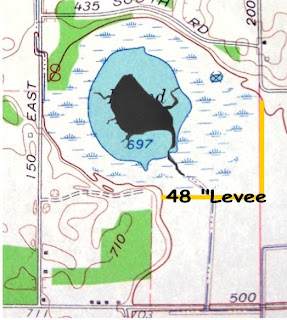
I examined and photographed a U.S. Geological Survey map that was based on aerial photographs taken in 1958. (Denham Indiana Quadrangle 7.5 Minute Series Topographic 1962). I then superimposed the terraserver-usa satellite photograph of Round Lake onto the 1958 lake profile. And here is the result:


Map from 1958 Aerial Photos


above: Black Outline is Present Profile


below: terraserver-usa.com photoBelow: 1871 Platt Map


Below: going, going...


The Division of Fish and Wildlife manages this 140-acre property as a wetland. It seems that the surface area has declined by 60% to 75% since 1958. I assume that a small part of this shrinkage is due to the entropic nature of this lake. Because of the magnitude of the shrinkage, I assume that the Department of Natural Resources has intentionally lowered the lake level. I certainly wonder about their definition of the terms “wetland”and "conservation". It seems to me that this beautiful natural asset has been considerably damaged. I have asked the Indiana Department of Natural Resources for comment on this matter.

1876 Township Map


The map above from 1876 shows both Cedar Lake (Bass Lake) and Round Lake. Bass Lake is almost exactly the same size now as it was in 1876. The Lake level has been maintained by a very simple gate at the drainage point. It is my understanding that when the Round Lake was privately owned, a gate maintained the level. I think that it would be a simple matter to restore the lake to the 1958 level. Restoring the 1871 Level would be much more difficult but should be considered. A modest levee on the east half of the south boundary and on the south half of the bast boundary of the Conservation Area should do the trick. The contours of the 1871 lake seem to coincide with the 700-foot elevation on the topographic map. That is only 3 feet above the 1958 level. The levee would be only need to be about 48 inches high.


1871 platt map and 1876 township map from the collection of Starke County Public Library's online collection. http://www.scpl.lib.in.us/historical/